- Home
- News
- Dynamic Checkweigher Application Case Study: Improving Weight Control in Coffee Bag Packaging
Dynamic Checkweigher Application Case Study: Improving Weight Control in Coffee Bag Packaging
Dynamic Checkweigher Application Case Study: Improving Weight Control in Coffee Bag Packaging
1. Industry Background
Coffee manufacturers operate in a highly competitive food-processing environment where product consistency, packaging accuracy and production efficiency directly influence customer satisfaction and operating costs.
Whether the product is roasted coffee beans, ground coffee or specialty coffee blends, accurate filling is an important part of the packaging process. A package that is underweight can create customer complaints, while excessive overfilling increases product giveaway and reduces production profitability.
For modern coffee manufacturers, manual weight checking is increasingly unsuitable for high-volume production lines. A continuous online checkweigher can inspect packaged coffee products automatically without stopping the production process.
In applications where coffee bags are produced at high speed, an automatic checkweigher provides an additional quality-control stage after filling and sealing.
The checkweigher can continuously measure the actual weight of individual packs, identify products outside the specified weight tolerance and activate an automatic reject system when required.
This makes a dynamic checkweigher an important part of an integrated coffee packaging inspection solution.
2. Customer Production Challenges
A typical coffee packaging line may handle different package formats, including:
- Stand-up pouches
- Flat coffee bags
- Vacuum coffee bags
- Foil-lined coffee packaging
- Plastic laminated bags
The actual product may be roasted coffee beans or ground coffee, with different target weights depending on the customer’s product range.
For example, a coffee manufacturer may produce 250 g, 500 g and 1 kg packages on the same production line.
This creates several quality-control challenges.
Inconsistent Filling
Even when a modern filling machine is used, minor variation can occur because of product density, particle size, filling speed, machine vibration and material flow characteristics.
Coffee beans are especially sensitive to bulk-density variation.
Two bags with a similar physical volume can have slightly different actual weights.
Product Give-Away
Overfilling every package is a common method used to reduce the risk of underweight products.
However, excessive filling means the manufacturer is continuously giving away additional coffee.
For high production volumes, even a small increase in product giveaway can create a significant cost.
Underweight Product Risk
An underweight coffee bag may fail internal quality-control requirements or customer specifications.
It can also result in complaints, rejected shipments or reputational problems.
A dynamic checkweigher provides 100% online weight inspection rather than relying only on periodic manual sampling.
High Production Speed
Coffee packaging lines are frequently designed for continuous operation.
Stopping the line to weigh products manually is inefficient.
The inspection system therefore needs to operate inline and maintain stable weighing performance while products move continuously on the conveyor.
3. Why Traditional Inspection Methods Are Not Enough
Manual inspection can be useful for quality audits, but it has limitations when applied to continuous food production.
An operator may manually select several packages every few minutes and check their weight with a bench scale.
The problem is that this only represents a small sample of total production.
For example, if thousands of coffee bags are produced during a shift, manually checking several bags cannot guarantee that every package meets the specified target weight.
There are also human-factor issues.
Operators may miss a product, record data incorrectly or fail to identify a short-term filling problem.
A dynamic checkweigher solves this problem by inspecting each product individually as it travels through the production line.
Instead of:
Packaging → Manual Sampling → Periodic Inspection
the production process becomes:
Packaging → Automatic Weighing → Weight Classification → Automatic Reject → Finished Product
This provides much more consistent weight control.
4. Fanchi-tech Dynamic Checkweigher Solution
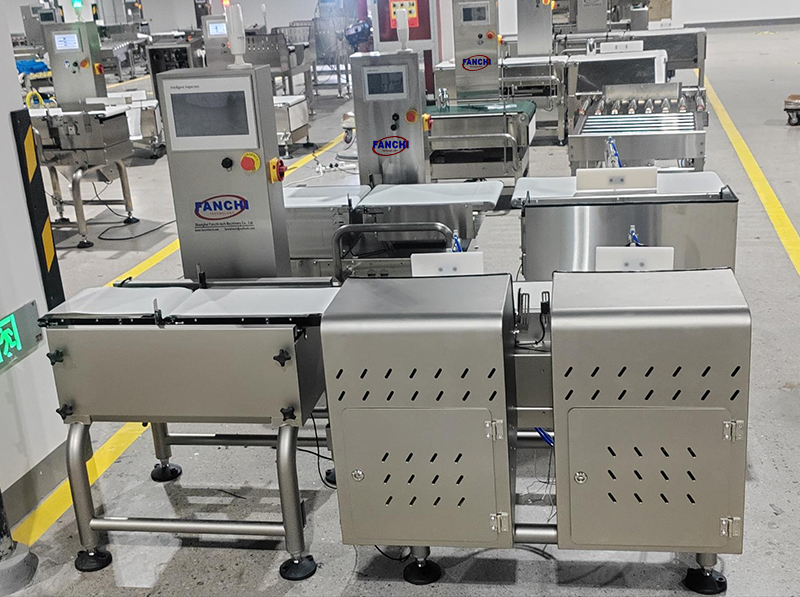
For this coffee packaging application, the Fanchi-tech machine shown in the image can be positioned as a Dynamic Checkweigher / Inline Checkweigher installed after the coffee packaging machine.
The product enters the conveyor continuously.
As each coffee bag reaches the weighing section, the system measures its dynamic weight while the product is moving.
The control system then compares the measured weight with the predefined acceptable range.
Products can be classified into:
Underweight → Reject
Within Tolerance → Accept
Overweight → Reject or Control According to Customer Requirements
This provides automatic weight inspection without requiring manual intervention for every pack.
The machine’s stainless-steel industrial construction is also suitable for food-processing environments where cleaning, durability and hygienic equipment design are important considerations.
5. Machine Configuration Matching the Coffee Application
Conveyor-Based Inspection
The machine uses a conveyor configuration, allowing packaged products to enter and leave the weighing section continuously.
This is important for automated coffee packaging lines.
Dynamic Weighing
Unlike a static bench scale, the product is weighed while moving through the production line.
This enables 100% product inspection without stopping the conveyor.
Automatic Reject
An automatic rejection stage can be integrated after the weighing section.
When an underweight or overweight coffee bag is identified, the reject mechanism removes it from the accepted product flow.
The exact reject mechanism should be selected according to the customer’s package dimensions, product weight, line speed and available installation space.
Stainless-Steel Construction
The equipment shown uses a stainless-steel structure, which is well suited to food-processing and packaging environments.
Inline Installation
The machine can be positioned after:
Coffee Roasting → Grinding → Filling → Sealing → Checkweighing → Reject → Final Packaging
The actual installation position depends on the customer’s packaging line configuration.
6. Recommended Coffee Packaging Process
A typical application can be structured as follows:
Coffee Beans
↓
Roasting
↓
Cooling
↓
Grinding / Blending
↓
Automatic Filling
↓
Bag Sealing
↓
Dynamic Checkweigher
↓
Weight Inspection
↓
Automatic Reject
↓
Qualified Coffee Bags
↓
Carton Packing
↓
Shipping
The checkweigher provides a final online weight-control point before secondary packaging.
This is particularly useful for manufacturers exporting coffee products to overseas markets where consistent package weight is an important part of product quality management.
7. Key Benefits for Coffee Manufacturers
7.1 100% Online Weight Inspection
Instead of inspecting only samples, the dynamic checkweigher can inspect individual packages as they pass through the production line.
This significantly improves weight-control coverage.
7.2 Reduce Product Giveaway
Accurate weighing can help manufacturers avoid unnecessary overfilling.
The goal is not simply to detect underweight products.
It is also to maintain a more controlled filling process so that the actual average package weight stays close to the target.
7.3 Detect Underweight Products Automatically
Underweight coffee bags can be removed automatically before entering downstream packing or shipping processes.
This reduces the chance of non-conforming products reaching customers.
7.4 Improve Production Efficiency
Because weighing takes place inline, operators do not need to manually stop the line for every inspection.
This allows the packaging line to maintain continuous operation.
7.5 Support Quality Control
Weight data can become part of the manufacturer’s overall production quality-control process.
For large coffee factories, the checkweigher can serve as an important inspection point between primary packaging and secondary packaging.
8. Why Choose Fanchi-tech for Coffee Packaging Inspection?
Shanghai Fanchi-tech Machinery Co., Ltd. focuses on industrial inspection equipment for food and packaging applications.
For customers purchasing a checkweigher, equipment selection should not be based only on the machine’s nominal weighing capacity.
The actual application needs to be evaluated, including:
- Product type
- Product weight
- Bag dimensions
- Conveyor width
- Production speed
- Product spacing
- Weight tolerance
- Reject requirements
- Environmental conditions
- Upstream packaging equipment
- Downstream packaging equipment
This application-based approach helps ensure that the checkweigher configuration matches the actual production line.
For coffee manufacturers, Fanchi-tech can provide a customized inspection solution according to the customer’s packaging format and production requirements.
The company’s inspection equipment portfolio also includes:
Industrial Metal Detectors
Online Checkweighers
X-ray Inspection Systems
Combination Inspection Systems
For a complete food inspection line, checkweighing can therefore be combined with metal detection or X-ray inspection when required.
9. How to Select a Checkweigher for Coffee Bags
When purchasing a checkweigher for a coffee packaging line, buyers should provide several key parameters to the equipment manufacturer.
1. Target Product Weight
For example:
250 g
500 g
1 kg
The weighing range directly affects the machine configuration.
2. Bag Dimensions
Provide the length, width and height of the package.
Flexible pouches and rigid packages may require different conveyor settings.
3. Production Speed
The manufacturer should specify the expected number of packages per minute.
For example:
XX packs/min
The final equipment configuration should be based on actual production requirements rather than a generic speed specification.
4. Weight Tolerance
The customer should define the acceptable minimum and maximum package weight.
5. Reject Method
Depending on the product and packaging format, the system can be configured with an appropriate automatic reject mechanism.
6. Production Line Layout
The available installation space, conveyor height and upstream/downstream equipment should also be considered.
This is especially important when replacing an existing checkweigher.
10. Customer Benefits Summary
For a coffee packaging manufacturer, a properly configured dynamic checkweigher can help achieve:
Better weight consistency
Reduced product giveaway
Lower risk of underweight products
100% online inspection
Reduced manual inspection
Higher packaging-line efficiency
Improved quality control
More reliable finished-product compliance
The value of a checkweigher therefore extends beyond simply measuring weight.
It becomes part of the manufacturer’s overall quality control and production efficiency strategy.
11. FAQ
Q1: What is a dynamic checkweigher?
A dynamic checkweigher is an automated weighing machine that measures products while they are moving on a conveyor.
It is widely used for inline weight inspection in food and packaging production lines.
Q2: Can a checkweigher inspect coffee bags?
Yes. A properly configured checkweigher can be used to inspect packaged coffee products such as coffee bean bags and ground coffee bags.
The final configuration should be selected according to product weight, package size and production speed.
Q3: Can the checkweigher detect underweight coffee bags?
Yes. The system can compare the measured product weight against preset weight limits and identify products outside the acceptable range.
Q4: Can overweight products also be detected?
Yes. The control system can define both lower and upper weight limits so that underweight and overweight products can be identified.
Q5: Can a checkweigher work continuously?
Yes. Dynamic checkweighers are designed for continuous inline production environments.
Products are weighed while moving through the conveyor instead of being manually placed on a static scale.
Q6: Can a checkweigher automatically reject bad products?
Yes. An automatic reject system can remove products outside the defined weight limits.
The appropriate reject method depends on the product characteristics, package dimensions and production speed.
Q7: What information is required to select a coffee bag checkweigher?
The most important parameters include target weight, package dimensions, production speed, weight tolerance, conveyor requirements and reject requirements.
Q8: Can a checkweigher be integrated with other inspection equipment?
Yes. Depending on the production line, a checkweigher can be combined with a metal detector or X-ray inspection system to provide a more complete food inspection solution.
Q9: Does a coffee factory need a checkweigher if the filling machine is already accurate?
A filling machine can provide accurate filling, but actual product weight can still vary due to product characteristics and operating conditions.
An inline checkweigher provides an additional verification stage for finished packages.
Q10: How can I choose the right checkweigher for my coffee packaging line?
The equipment should be selected according to the actual product weight, package dimensions, production speed, conveyor configuration, acceptable weight tolerance and reject method.