- Home
- News
- Bulk Food X-ray Inspection System Case Study: Improving Safety and Quality Control in Coffee Bean Processing
Bulk Food X-ray Inspection System Case Study: Improving Safety and Quality Control in Coffee Bean Processing
Bulk Food X-ray Inspection System Case Study: Improving Safety and Quality Control in Coffee Bean Processing
1. Industry Background
Global coffee consumption has maintained steady growth over the past decade, driven by booming demand for specialty coffee, ready-to-drink products and traceable, high-quality beans. North America and Europe remain the world’s largest import markets, where regulators such as the FDA and EFSA, together with third-party certification schemes including HACCP, BRCGS and IFS Food, enforce increasingly stringent food safety requirements.
For coffee roasters, importers and processing facilities, foreign body contamination is one of the most critical operational risks. Raw green coffee beans travel long supply chains from farms to processing plants, and may pick up stones, metal fragments, glass shards, plastic particles and other dense contaminants during harvesting, drying, transportation and primary processing. A single contamination incident can trigger product recalls, customer complaints, certification suspension and lasting damage to brand reputation.
As a result, modern coffee processing lines are widely adopting automated inline inspection technologies. X-ray inspection systems have become the preferred solution because they detect not only metal but also high-density non-metallic contaminants that traditional metal detectors cannot identify. For bulk, unpackaged coffee beans, a dedicated bulk-feed x-ray system delivers the highest accuracy and throughput while integrating seamlessly into existing production workflows.
2. Customer Production Challenges
This case is based on a mid-sized specialty coffee roaster in Oregon, USA, processing approximately 1,200 tons of green coffee beans per year. The company supplies roasted whole beans and ground coffee to regional supermarkets, cafes and e-commerce channels, and holds BRCGS certification for its production facility.
Product and production characteristics:
- Core products: raw green coffee beans from multiple origins, roasted whole beans
- Product form: loose, dry, granular bulk material with uniform particle size
- Production capacity: 600 kg per hour on the main cleaning and grading line
- Packaging: 1kg retail bags and 25kg bulk sacks after roasting
- Main contamination sources: stones, soil particles, metal wire fragments from farm equipment, and small glass pieces from transport containers
Before installing the Fanchi-tech x-ray system, the customer relied on manual visual sorting and traditional gravity metal detectors at the raw material receiving stage. The quality team faced three persistent problems:
- Manual sorters missed small-density stones and glass pieces, especially at high throughput speeds.
- Metal detectors could not alert operators to non-metallic contaminants such as rocks and ceramics, which are the most common foreign bodies in green coffee.
- Sampling-based quality checks covered only about 5% of total production, leaving hidden batch risks.
In the 12 months before the upgrade, the customer recorded three customer complaints related to foreign objects in roasted beans, and came close to failing a BRCGS surveillance audit due to insufficient contamination control measures.
3. Why Traditional Inspection Methods Were Not Enough
The customer evaluated several improvement options before selecting x-ray technology, and concluded that traditional approaches could not fully address their risk profile.
Manual visual sorting Human inspectors can only maintain consistent focus for short periods, and detection accuracy drops sharply as line speed increases. For 600 kg/h bulk bean flow, manual sorting requires 3–4 full-time operators and still has an estimated 20–30% miss rate for small contaminants. Labor costs are high and output standards are difficult to unify.
Conventional metal detectors Metal detectors perform well for ferrous and non-ferrous metal contamination, but cannot detect stones, glass, ceramics or dense plastic — the most frequent foreign bodies found in green coffee. This left a major safety gap that the customer could not close with metal detection alone.
Sampling inspection Batch-by-batch sampling reduces inspection efficiency and provides no guarantee that contaminated product will be caught. Contaminants are typically randomly distributed, so sampling carries inherent statistical risk that is unacceptable for certified food manufacturers.
Operational and commercial impact Beyond safety risks, insufficient inspection created operational friction: production managers had to slow line speeds during peak seasons, rework batches after quality alerts, and spend significant management time on audit preparation and customer complaint resolution.
4. Fanchi-tech Solution
After detailed application assessment and sample testing, the customer selected the Fanchi-tech FA-XIS Series Bulk Food X-ray Inspection System configured for loose dry food products. The system was installed directly after the bean cleaning and grading station, and before the roasting silos, to remove contaminants early in the process and protect downstream roasting equipment.
Inspection principle The system uses a low-dose x-ray generator and high-resolution linear detector array to capture real-time images of product flowing across the conveyor belt. An integrated image processing algorithm analyzes density differences between coffee beans and foreign materials, and automatically triggers the rejection mechanism when a contaminant is identified. The x-ray dose is well below international food safety limits and does not affect bean quality, flavor or shelf life.
Detection capability For standard green coffee beans, the system reliably detects:
- Ferrous and non-ferrous metals from 0.3 mm
- Stainless steel fragments from 0.4 mm
- Glass and stone particles from 0.5 mm
- Dense ceramic and hard plastic from 0.8 mm
Automatic reject system The machine is equipped with a high-speed pneumatic rejection nozzle that accurately diverts contaminated product into a dedicated reject bin. The rejection action is synchronized with product position tracking, minimizing good product loss while ensuring 100% removal of detected contaminants.
Continuous inline operation The system operates 24 hours per production shift without manual intervention. It features a user-friendly touchscreen HMI with multi-language support, real-time production statistics, defect logging and one-click recipe switching for different bean varieties and throughput settings.
Line integration The inlet side connects to the customer’s existing bucket elevator and vibrating feeder, while the outlet side discharges directly into the roasting plant’s bulk conveying system. The compact footprint allows installation without major line reconstruction.
5. Machine Configuration Matching This Application
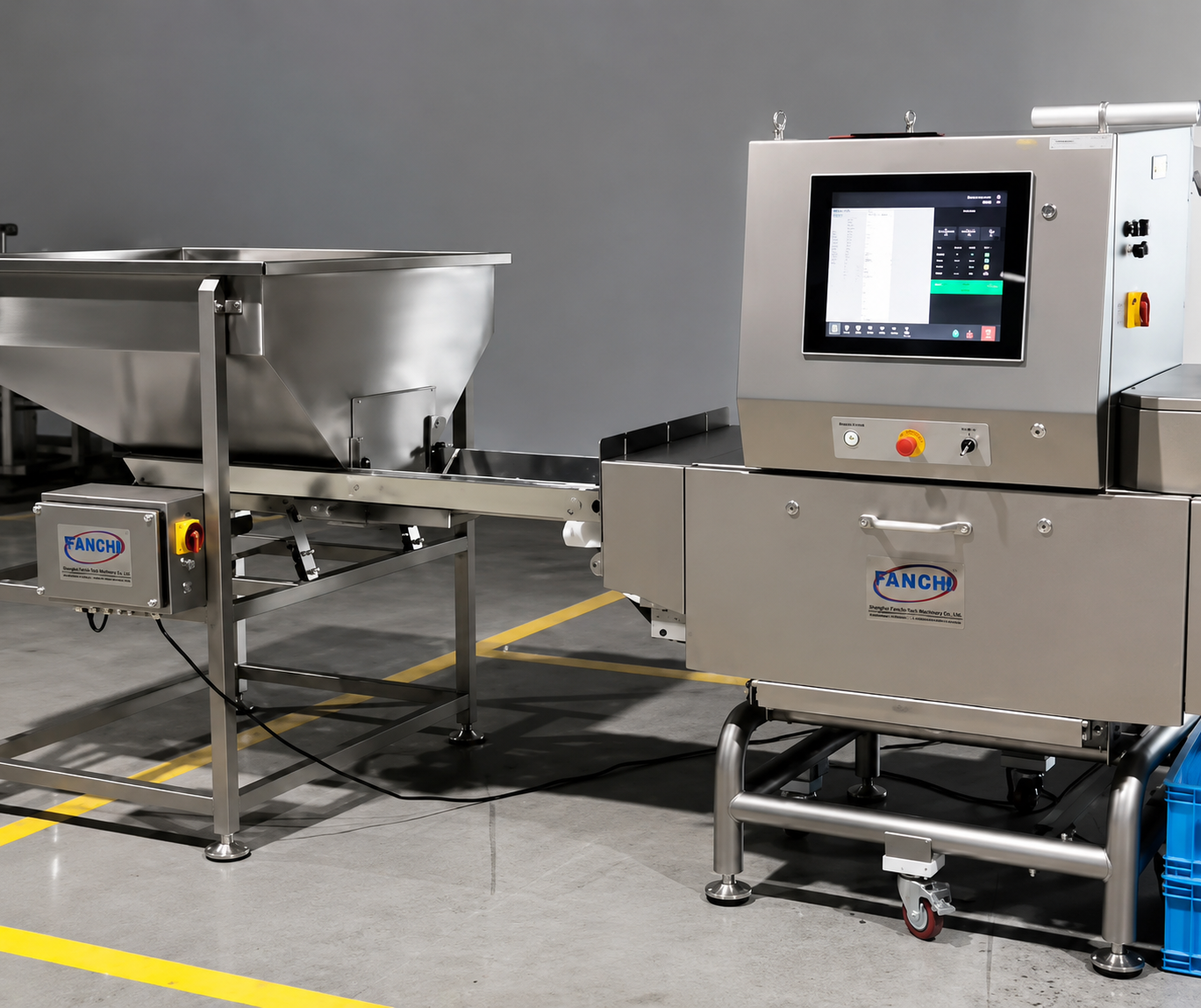
The FA-XIS bulk x-ray system was customized to match the customer’s coffee bean production parameters, based on the bulk x-ray platform shown in the equipment photo.
表格
| Parameter | Specification for coffee bean application |
|---|---|
| Conveyor width | 300 mm food-grade PU belt, suitable for uniform distribution of loose beans |
| Detection aperture | Optimized for thin-layer bulk product flow, compatible with 300mm product width |
| Product throughput | 300–800 kg/h, adjustable to match upstream cleaning line speed |
| Conveyor speed | 15–30 m/min, variable frequency controlled |
| Material compatibility | Dry, granular, free-flowing bulk products with consistent density |
| Construction | Full 304 stainless steel frame and product contact parts, suitable for dry food production environments |
| Feeding system | Integrated stainless steel hopper and vibrating feeder for even product layering |
| Mobility | Adjustable stainless steel feet + lockable casters for flexible line positioning |
This configuration ensures that coffee beans spread into a thin, single layer as they pass through the x-ray tunnel, maximizing detection accuracy and preventing overlapping beans from masking small contaminants.
6. Application Process
The x-ray inspection station is placed at the raw material preparation stage, before roasting, to protect both downstream equipment and final product quality. The full production flow is as follows:
- Raw Material Receiving — Green coffee beans arrive in 60kg jute sacks and are loaded into the intake hopper.
- Cleaning & Grading — Beans pass through a destoner, screen grader and magnetic separator to remove large debris and obvious metal.
- X-ray Inspection — Beans are fed in a uniform thin layer onto the Fanchi-tech x-ray conveyor. The system scans every bean in real time.
- Automatic Rejection — When a contaminant is detected, the pneumatic reject system activates and diverts the contaminated portion into a sealed reject bin for manual verification.
- Temporary Storage & Roasting — Inspected beans are conveyed to silos and fed into the roasting drum according to production schedule.
- Grinding & Packaging — Roasted beans proceed to grinding, blending and final packaging.
- Finished Goods — Packaged products move to warehousing and distribution.
By locating x-ray inspection early in the process, the customer also prevents hard stones and metal from entering expensive roasting equipment, reducing maintenance costs and extending machine service life.
7. Customer Benefits
Six months after installation, the customer completed a formal performance review and reported measurable improvements across quality, efficiency and compliance.
Reduced contamination risk The system achieved a 99.9% detection rate for calibrated test contaminants, and captured multiple stone and glass fragments that would have passed previous inspection methods. No foreign body complaints were recorded in the six-month evaluation period.
Improved production efficiency Line speed increased from 400 kg/h to 600 kg/h without sacrificing inspection quality. The customer eliminated three manual sorting positions and reallocated staff to higher-value tasks. Overall line throughput improved by approximately 35% during peak season.
Reduced customer complaints and recall risk Zero product complaints related to foreign bodies were reported post-installation. The quality team estimates that avoiding even one retail-level recall saves tens of thousands of dollars in logistics, reputation and remediation costs.
Meets food safety standards The x-ray system was accepted as a core CCP (Critical Control Point) in the customer’s HACCP plan, and the facility passed its BRCGS surveillance audit with a higher grade than the previous cycle.
Improved export and retail competitiveness With documented 100% inline inspection capability, the customer qualified for several large retail and private-label contracts that require advanced foreign body control as a supplier prerequisite.
8. Why Choose Fanchi-tech
Shanghai Fanchi-Tech Machinery Co., Ltd. is a professional manufacturer focused on food inspection and quality control equipment, with product lines covering x-ray inspection systems, metal detectors, checkweighers, hair sorting machines and packaging automation equipment.
- Proven industry experience As a 9-year verified gold supplier on Alibaba with 100% response rate and a global track record, Fanchi-tech operates from multiple locations in Shanghai, Zhejiang and Henan as a group company. Its inspection equipment is supplied and supported in over 50 countries through a worldwide network of OEM and distributor partners.
- In-house manufacturing capability With its own ISO-certified sheet metal fabrication facility, Fanchi-tech handles the full production cycle from pre-production prototypes to high-volume runs, completing all fabrication and finishing in-house. This ensures high quality, short lead times, competitive pricing and excellent availability of spare parts.
- Customized solutions From conveyor width and aperture size to rejection mechanisms and communication protocols, each system can be adapted to existing production layouts and automation systems. OEM and ODM services are fully supported to meet specific customer requirements.
- Full international certifications All food-grade systems are built with food-grade 304 stainless steel and hold CE certification, FDA compliance, ISO 9001 quality management certification, ISO 14001 environmental management certification and ISO 45001 occupational health and safety certification, meeting major global food equipment safety standards.
- Full-cycle service support Customers receive pre-sales application testing, professional installation guidance, operator training and after-sales technical support to ensure stable long-term equipment performance.
9. FAQ
Q: Can an x-ray inspection system detect stones in raw green coffee beans? A: Yes. X-ray systems identify contaminants by density difference. Stones, ceramics and glass have higher density than coffee beans and appear clearly on x-ray images, making them highly detectable even at small sizes.
Q: What types of contaminants can a bulk x-ray machine find in loose food products? A: A bulk x-ray inspection system can detect ferrous metal, non-ferrous metal, stainless steel, glass, stone, ceramics, dense plastic, bone and other high-density foreign bodies in loose and granular food products.
Q: Is x-ray inspection safe for coffee beans and food products? A: Yes. Industrial food x-ray systems operate at very low dose levels well below international food safety limits. The x-ray exposure does not change the chemical composition, flavor, nutrition or shelf life of food products.
Q: How fast can a bulk x-ray system process coffee beans? A: Throughput depends on product size, required sensitivity and belt width. For the FA-XIS bulk configuration used in this case, typical throughput for green coffee beans is 300–800 kg per hour at standard sensitivity settings.
Q: Does x-ray equipment meet HACCP and BRC food safety standards? A: Yes. Properly validated x-ray inspection systems are widely accepted as Critical Control Points in HACCP plans and fulfill the foreign body control requirements of BRCGS, IFS, SQF and other GFSI-recognized certification schemes.
Q: Can the x-ray machine be integrated into an existing coffee processing line? A: Yes. Fanchi-tech bulk x-ray systems can be integrated with existing bucket elevators, vibrating feeders, belt conveyors and downstream silos or packaging machines. Standard signal interfaces and adjustable inlet/outlet heights support most line layouts.
Q: What certifications do Fanchi-tech x-ray inspection systems have? A: Fanchi-tech food x-ray systems are CE certified, FDA compliant, and manufactured under an ISO 9001 certified quality management system. They also meet ISO 14001 and ISO 45001 management standards.
Q: Can this system inspect other bulk dry foods besides coffee beans? A: Yes. The same bulk x-ray platform can be used for nuts, seeds, grains, spices, sugar, dried fruit, vegetables, pet food kibble and other free-flowing dry granular products. Operators can switch between product recipes via the touchscreen.